
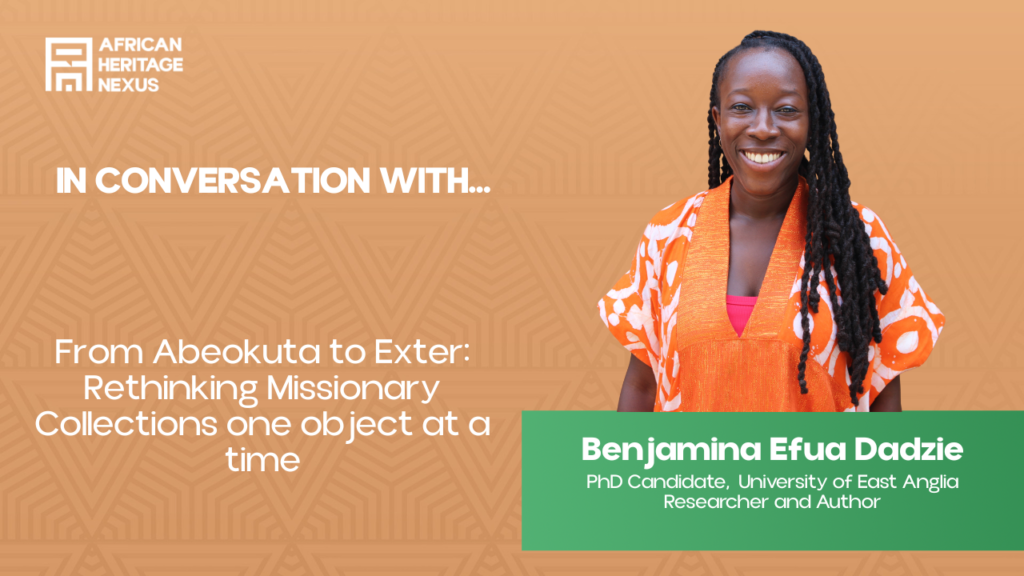


In this episode, we speak with Benjamina Efua Dadzie, a PhD candidate at the University of East Anglia, whose research focuses on Anglican missionary activities in Abeokuta (1842–1867). Drawing on archival records and objects collected by Reverend Henry Townsend for the Church Missionary Society (CMS), Benjamina explores the layered histories behind Egba material culture now held in the Royal Albert Memorial Museum, Exeter.
Her recent article, Collecting Abeokuta, traces the provenance of Egba artifacts collected by Reverend Henry Townsend for the Church Missionary Society and now held in the Royal Albert Memorial Museum. These objects from the ceremonial sword of Chief Ogunbona to Esu figures reframed as “trophies of conversion” reveal the complex negotiations behind missionary collecting practices.
The discussion highlights the politics of exchange in nineteenth-century Abeokuta, challenging missionary accounts that described objects as “gifts” freely offered. Instead, Benjamina introduces the idea of “handover” a term that better captures the obligations, negotiations, and strategies behind the transfer of items such as the ceremonial sword of Chief Ogunbona and Esu figures.
She also reflects on how these objects were reinterpreted in Britain displayed as evidence of conversion and Christian triumph, shaping Victorian views of Africa. Importantly, this conversation reminds us that provenance research is not simply about where an object comes from, but about recovering the voices and intentions of those often erased from the archive. It is a timely contribution to ongoing debates about restitution, museum practice, and the ethical stewardship of African heritage.
Crucially, her work also points toward the importance of collaboration between archives and communities, between researchers and local histories, and between institutions in the UK and Nigeria.
Photo credit: Folayemi Brown